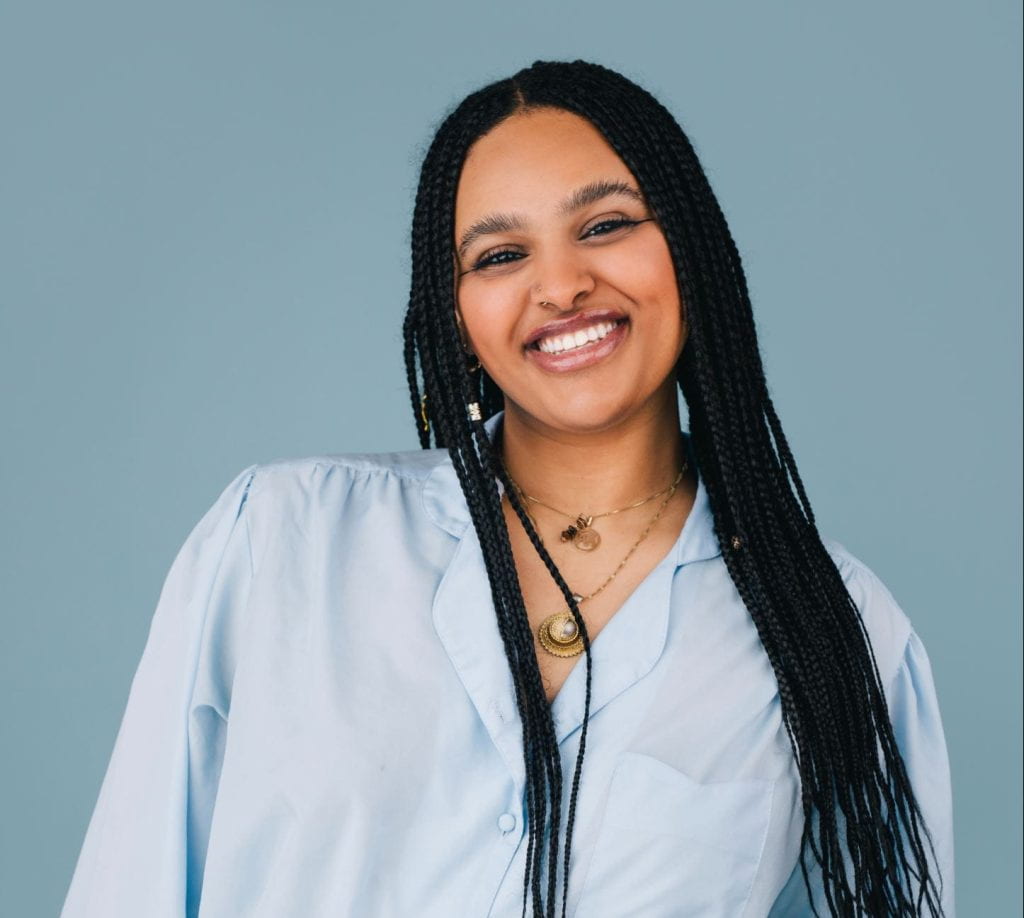
Andie Aymond

This picture was captured in Seongsu-dong, an area in Seoul that is famous for its popups that feature different brands. This specific popup was for Gentle Monster’s Bratz collection.

NAME: Andie Aymond

MAJOR: Global Studies

PROGRAM: SJSU Exchange – Sungkyunkwan University – Spring 2025

EMAIL: andie.aymond@sjsu.edu

BIO:

My name is Andie, I am a community college transfer, majoring in Global Studies with a minor in Advertising and I will be graduating at the end of this semester. I studied at SKKU this past spring semester in Seoul. When I was in High School, I made it a goal of mine to study in South Korea as I was interested in exploring my grandmother’s birth country. I wanted to explore her home country and experience the culture firsthand while also working towards completing my degree. 

GOALS: What were your goals for studying abroad?

My goals for studying abroad were mainly personal. I wanted to become a more independent person which was achievable by traveling to a different country alone. As a transfer student and commuter, I felt like I missed out on the typical college experience, dorming and living on/near campus. Studying abroad definitely satisfied part of my college experience. Another goal I had was to build connections with people and challenge my conversational skills. Lastly, I set out to visit family living in South Korea that I had not initially gotten the chance to meet in person.

 PERSONAL GROWTH: What was the biggest impact that your study abroad experience had on you?

Studying abroad had the biggest impact on my mental health. Being fully independent and having access to everything by foot really helped with stress, anxiety and depression. I felt so productive in my time in Korea especially as I could really relax, have fun and just focus on school. Additionally, I feel that I became more resourceful.

 ACADEMICS: How would you describe your academic experience abroad?

I took courses that would satisfy my upper division major courses. This included Social Welfare, Sociology, Public Management, and Policy courses. I also took 6 units of Korean language. My experience in a new academic environment was overall positive, and I felt that I managed my grades and course load efficiently. My chosen courses did not set me back and even though I took 18 units in total, I was able to achieve a 4.0 semester while having fun and exploring. 

 CAREER: What skills did you learn / sharpen during your study abroad experience?

While I did not specifically take on career based skill building, I feel I have made some improvements in myself that would be useful in my future career. For example, I feel that I gained stronger self advocacy, networking, and communication skills which would translate well into a professional environment. 

COMMUNITY ENGAGEMENT: How has your immersion impacted your perspectives on the world?

Meeting many other international students made me realize how competitive academics are in other parts of the world compared to the United States. Also meeting so many other students made me realize that our generation across countries have many similarities in the ways we think. I am now also left to reflect on the inefficiencies in American society compared to Asian countries, specifically in terms of the “walkable cities” and public transportation systems. 

FUTURE: How has study abroad prepared you for your future?

After studying abroad, I now feel more open to seeking employment or higher education opportunities outside of the US postgrad. 

TIPS: What advice would you give to future Global Spartans?

Save as much money as possible so you can enjoy your studies and exploring without constantly worrying about pinching pennies. Bring less stuff than you think you need because you will buy so much stuff. Make friends with the other international students, even if you are going with a friend from SJSU, it is better to be open to building connections with native and international students. 

Alexander Melgar

Taken in the midst of Shimanami Kaido, an 80+ km bike ride from Onomichi to Imabari, and crossing the Seto inland sea. Taken on Innoshima, Hiroshima Prefecture.

NAME: Alexander Melgar

MAJOR: Global Studies

PROGRAM: SJSU Exchange – SJSU Exchange – Okayama University (EPOK) – Spring 2025, Summer 2025

EMAIL: alexander.melgar@sjsu.edu

BIO:

I’m Alex, a Global Studies Major. I studied abroad because I’ve always wanted to experience life in another country, but that’s difficult to do without working there, which means you need to already know the language, the norms, and have connections. With this in mind, study abroad is a rare opportunity to throw yourself into something completely foreign to yourself and your life up to that point, without the dangers of failure: there’s enough handholding to make sure you survive, but enough room to experience things as they are.

GOALS: What were your goals for studying abroad?

My goals while studying abroad were relatively simple:

  • To see if I liked Japan, given I’ve had a long interest, and would possibly want to go back for other extended periods of time.
  • Try new things
  • Learn the depth of cultural differences that can exist, and get a better feel for human nature, as well as social structuring of life and society

 PERSONAL GROWTH: What was the biggest impact that your study abroad experience had on you?

I feel like in a lot of ways I’ve become a new, more open person. Beforehand, I was a lot more quite with my friends, but now I feel a lot more confident, as well as having better identified some more areas of myself, my skillset, and my personality that I’d like to keep working on going forwards.

 ACADEMICS: How would you describe your academic experience abroad?

My Academic experience was varied. Some classes were incredibly simple, straightforward, and were ultimately easy, but others, namely language courses were challenging. Okayama University has Language classes that range from zero knowledge up through about high school level, and each course is 4 units in a quarter, which equates to 8 hours per week. These classes are incredibly intense, and the particular class I was in, the second level, is the border between beginner and intermediate. It’s intense, a little random, and I tried my best, but it was a bit much.

 CAREER: What skills did you learn / sharpen during your study abroad experience? With my broadened horizons, I got a much better feel for cross-cultural communication, given I found it very easy to surround myself with non-americans at almost all times. I improved my Japanese ability a lot as well, on account of the complete immersion, as well as the intensive classes I was taking. Through volunteering at L-Cafe, I learned a lot more about teaching, and just how much work it takes to make a lesson plan, keep people engaged, and ultimately get points across as well as develop skills.

COMMUNITY ENGAGEMENT: How has your immersion impacted your perspectives on the world? My immersion has greatly changed my perspective of the world: I spoke to so many other exchange students, namely from Europe, who gave me lots more eyes into the range of cultures that exist than I’d originally hoped for. I got to see discussions, hear new languages, and forge friendships with people I’d never thought I’d meet, and it broadened my horizons, as well as allowed me to put a face to so many places I’ve only occasionally read the names of, or seen in history lessons.

FUTURE: How has study abroad prepared you for your future?

I wanna go back…

I feel a strong pull back to Japan, having lived there, made use of their univeral health insurance (I broke a toe), seen and lived through the low rent prices, been able to ride my bike anywhere in the city with safety and ease, seen the ease of getting part time work, as I saw with my fellow, though longer term exchange students, and got to use the train system, I really miss a lot of elements that made life easy, nice, convenient, and worry-free, even with things sucked (Broken toe).

TIPS: What advice would you give to future Global Spartans?  

This is a little long, but generally:

Buy a bike and don’t rent one, plan leaving a lot sooner than I did, say hi to people all the time, go to L-cafe as often as you can, sign up for all the Fujimoto sensei trips you can, as well as all of her classes. Join a club or at least try, befriend Sam the american, befriend Varun (he’s chill), apply for a library card asap, stay the full year and not only half if you can, don’t fly into Momotaro cause it’s expensive, travel as much as you can, go to Lamu for groceries, get a membership at great pumpkin (karaoke), rely on Saida Sensei cause she will offer and is really nice (she bought me tape when I broke my toe), get LINE working ASAP, rely on your EPOK buddy even if they can’t speak english (worst case scenerio use google translate), go to memory (it’s a small restaurant behind the library with incredibly good food), and remember the trash times.

Rahel Adebabay

NAME: Rahel Adebabay
MAJOR: Global Studies
PROGRAM: Ireland, SJSU Exchange – University College Dublin
EMAIL: rachel.adebabay@sjsu.edu

BIO: Please tell us about you and why you chose to study abroad.

I am a first-generation Ethiopian-American college student pursuing a bachelor’s degree in Global Studies and three minors in Philosophy, Legal, and African American Studies at San Jose State University. I want to utilize my educational background to work towards my vision of building a prosperous, united Africa, emphasizing creating strong educational infrastructures.

Through this program, I came intending to gain a new perspective on the world. Traveling to another country and experiencing a non-American curriculum made me decenter from the American political perspective.


CAREER: What skills did you learn/sharpen during your study abroad experience?
Reflect on how your study abroad experience and the skills, knowledge, or networking has enhanced or contributed to your life back on campus or home.

Through decentering from the American perspective, I viewed the world in a much different way. This is especially important as a scholar in the field of International relations because this challenged my political beliefs, worldviews, and personal values. International Affairs cannot be seen from only one perspective, and acquiring added perspective will make me more analytical and critical in nature. In addition, acquiring such attributes and experience will make me an attractive candidate for my future educational pursuits and later professional life.

Because I am just finishing up my term abroad, I have yet to see it being applied to my life on campus. However, I without a doubt believe having an added perspective will make me a much better student in my Global Studies major courses.

GOALS: What were your goals for studying abroad?
Reflect on the personal, academic, and professional goals that you had set out to achieve on your study abroad experience?

Broadly speaking, my goal going into my experience was to be bold and brave. I wanted to try new things and immerse myself in different cultures.However, in retrospect, going into my study abroad experience I had a very uncompromising view of how my life should be during and after my experience. I knew I wanted to graduate within 3 years, take the LSAT in the summer, and do well in all nine classes I was enrolled in during my spring semester. My goals, although achievable, needed to be more flexible and restrictive.


PERSONAL GROWTH: What was the biggest impact that your study abroad experience had on you?(REQUIRED)

Although I initially intended to study abroad solely for academic purposes, I did the opposite. This experience made me realize I must slow down and take in life’s pleasures. This semester was the first time since sixteen that I have not worked. Along with the absence of work or pressures to keep me financially afloat, the workload at my school was significantly smaller than my usual course load, even with nine classes. This gave me the time to get to know myself through solo travel and do activities that I loved and previously did not have the time to attend to. Because of this experience, I’ve become more eager to travel in the not-so-distant future, and I know that my future career should have travel embedded into it. In addition, I realized that I perhaps want to live abroad as I feel the way of life in the United States is not sustainable compared to life in Ireland. Living in Ireland has exposed me to what life should be like, as I’ve never felt so safe, healthy, and happy.

ACADEMICS: How would you describe your academic experience abroad?
Share what courses you chose to take abroad and the strategies you used to ensure your academic success. How has the experience impacted your academics now that you have returned to SJSU?

My academic experience has been frustrating at UCD. Not so much because the content was challenging but because it was much different from what I was used to in the United States. None of my classes had homework or constant learning checkpoints. In addition, with my major being small at SJSU, with an average of 15 students, I was surprised by the hundreds of classmates I had. Because of this, I noticed a culture of not having strong interpersonal relationships with professors. This was very unusual to me as in nearly every class I’ve taken at SJSU, I’ve been in constant contact with my professors and even have developed those relationships beyond the course I’ve taken with them. However, I am very fond of UCD and all that it has to offer; I’ve never felt helpless because of the endless resources the school provides.

COMMUNITY ENGAGEMENT: How has your immersion impacted your perspectives on the world?

Apart from my academic life, I did a lot of solo traveling during my time abroad. Since my start, I have been to 7 countries I have never visited. Some I did not know much about prior to traveling there. Not only did I learn and immerse myself in the cultures that I encountered, but I pushed myself to engage with the community at every opportunity I had. I tried new foods, learned about different cultures and customs, made friends with locals, etc. Most importantly, I learned the values of self-sufficiency and independence while also getting to know myself better. Six of the seven countries I’ve visited are not English-speaking countries, and through that experience, I became a more effective communicator and navigator.

FUTURE: How has study abroad prepared you for your future?

The most prominent lessons I’ve learned from in my study abroad experience have been through my solo travels. I exclusively did solo travel as I felt this was fundamental to getting to know myself, and I did precisely that. Solo traveling throughout Europe has made me an effective communicator and navigator. For example, I spent three weeks in Central and Eastern Europe, where people did not know fluent English, and I had to navigate that, whether that was by using context clues, reading facial expressions, or pulling out google translate! In addition, solo traveling in non-English speaking countries has made me comfortable with being uncomfortable. I surrendered expectations and the constant need to stay within what was familiar to me.

TIPS: What advice would you give to a future Global Spartan?
  1. Apply to every scholarship available, no matter how impossible it seems. This was my experience applying to the Benjamin A Gilman International Scholarship. Because I decided to study abroad last minute, there was only one scholarship available to me which happened to be the most prestigious study abroad scholarship. I won the scholarship, although I applied just two hours before its deadline.
  2. Try to make a friend in every country you visit! Understand the local way of life.
  3. Take advantage of your school’s resources.
  4. If you are attending a European university, use a planner/tracker as the curriculum is primarily autonomous learning. Constantly new ways to engage yourself in your academics.
  5. Research the country that you are studying in. Understand lingo/language, customs, and political system. Three months before moving to Ireland and even before I went to a new country, I watched youtube videos that described social do’s/don’ts.
  6. Get to know and use public transportation. Across almost all European countries, transportation is reliable and safe.