Labora Expedition by M.A. Candidate, Sammer Abu AlRagheb

What started with an email became a full-on visual anthropological/ethnographical  expedition of Indigenous and Afro-Caribbean art in the Caribbean, precisely in the Lesser Antilles islands. This expedition became my fieldwork, intended to satisfy my thesis project for  my MA degree. The islands I explored during this study were Point a Pitre and Marie Galante in  Guadeloupe and Dominica, south of both islands mentioned. The latter island is independent of  its colonial edifice, while the former is still a French Department. My contact was Dave Perdew,  cap’n of the Labora and chief director of the Labora Caribbean Art Expedition. The ship Labora is a seventy foot, 60ton ketch built in the thirties for fishing purposes in Denmark. Dave  purchased the vessel in 2018 and decided to refit her into a sailing vessel, and for the last seven  years, he has been doing just that. The Labora Expedition is part of a sailing conglomerate  dedicated to preserving Indigenous and Afro-Caribbean art in the Caribbean. Dave, a visual  anthropologist, has organized this expedition for over two years. The expedition involves sail  training, sailing chores, and tasks, participating in various projects related to ecology and  oceanography, participant observation of local events and festivals, and ethical building of  rapport with the locals of whichever island the Labora visits, along with the process of  documentation, whether visual or physical logs. During the expedition, the sailors also learned  how to operate the vessel safely (handling lines and rigging, passage making, sail configuration,  and navigation rules). Critical maintenance was another learning experience, as well as electrical  skills, crew dynamics, and even plumbing. The expedition is ongoing, and any person or student  interested in joining the expedition is welcome. Now, they are moored or anchored off the city of  Pointe a Pitre on Guadeloupe Island.  

 Among my exploits of the three islands mentioned, I found that the Creole culture had an honest knack for art that expressed their feelings and told the stories of their ancestors. As  subjective as art is or can be, the meaning of its design will always be in the artist’s making and  their intentions in creating the art. We can attempt to interpret its meaning, albeit they are only  theories of interpretation. The People of Marie Galante were lively, affable, super genuine, and  eager to know where you came from. They are open to sharing stories and inviting you to their  social circles. Marie Galante, one of the smaller Gwada (Guadeloupe) islands, was a mixture of  Afro-Caribbean descendants, Creole and French occupants. A ferry from Pointe a Pitre lands in  Marie Galante and departs twice a day, and a good percentage of its boarders are tourists.  However, most of them are from other islands in the Lesser Antilles. Families, friends, and  partners separated by close waters. All the islands in these seas hold festivals every weekend.  

 These festivals (Gwoka festival) introduce a colorful barrage of stories that display the  history of Creolization, the African diaspora today, and their ancestors who arrived on the islands  by force during the TransAtlantic Slave Expansion. One of the instruments used, the heart of the  music festivals, is the Ka (big drum). While the average person will enjoy the beats and tempos  of the drums during the festival, which are spiky, moving, tribal, aggressive, and mind warps you  to dance, the beats have intentional meaning behind every stroke, hit, and measure in their notes.  

These drums commanded and led the entire festival, moving throughout the streets. The  intentional energy experienced while observing the festival move throughout the streets is an  explosion of a powerful resistance intended to challenge the colonial occupation and slavery  during the Age of Enlightenment. A statement that the children have not forgotten the past and  placing agency is merited; the past is much alive and lives within them daily.  

My good friend and cinematographer/videographer, Dustin Wagner, a graduate  archaeology student at Leicester University and a numismatist, lived on the Labora and  experienced the sailor’s life in the Caribbean. It was extreme, physically and mentally  demanding, but greatly rewarding. We were the only Americans, along with Dave; the crew  members came from various countries: Finland, England, Sweden, Cuba, Austria, Germany,  France, and Guadeloupe; later, another American joined, all with diverse ethnicities and  backgrounds. We all learned sailing and received a crash educational course on the cultural  history of these islands. Our mission, I and Dustin, was to capture as much footage as we could for my deliverable, a short documentary about the importance of preserving Afro-Caribbean and Indigenous art in the Caribbean, that will hopefully be exhibited in the Memorial Acte Museum  in Pointe a Pitre, Guadeloupe, once released.  

 The expedition also included day trips the crew partook in, where, as a joint team, we  stepped away from our daily chores as sailors and ventured to whichever island we anchored at.  In Marie Galante, we rented two vehicles and spent the day visiting historical sites, sandy  beaches with light azure waters, and rum distilleries that viewed screenings of their history. We  were building rapport with the locals while enjoying the restaurants and food life of the island.  By the end of our stay in Marie Galante, I was surprised that the locals started recognizing us as  the Labora crew.  

Building teaching and research experience overseas is a different ball game than locally  in California. As a student anthropologist, realizing that malleability and openness to the project  were essential traits, which was an unexpected turn. Being flexible became second nature just  days into the expedition; understanding the discourse and dialogue within the ship itself was the first lofty duty each sailor had to partake in. The same thing happened on shore; the locals  presented a collection of discourses, and being part of that discourse without any form of  discrimination was a blessing. These learning curves I experienced can only come from traveling  and exploring other cultures and heritages outside of the pockets of your town and city. Boots on  the ground and hands-on experiences are where you will find the viewpoint of the natives and  receive the grounded stories of the past.  


SJSU at the Southwestern Anthropological Association (SWAA) Conference

SJSU students attended the 93rd Annual Conference of the Southwestern Anthropological Association, “Transcending Boundaries”

What started with an offhand comment on joining Dr. Marlovits and Conor Brown at the annual SWAA conference turned into an ambitious time feat across four research topics. Dr. Marlovits’ undergraduate and graduate students were eager to represent SJSU in a panel titled, What are Skateboarders Grinding Against? Unofficial Spaces, Identities, and Performative Imaginaries. Undergraduates from Dr. Marlovits’ Skate lab, Conor Brown and Valeria Foxworthy Gonzalez, each developed a literature review of distinct skateboarding chronological representations. The first-year graduate students in Dr. Marlovits’ Applications Core II class culminated in two research projects on local San José skateboarding scenes. 

The students succeeded in coordinating among themselves, department Chair Dr. Charlotte Sunseri, and department analyst Anges Borja to receive grants for the conference. Other faculty members pitched in with their research knowledge, one going above and beyond to support the student-led research. Lecturer Gustavo Flores welcomed the panelists to practice their presentations to his class, shared research insight, and shared footage for a video compilation for the student research.

Connor began the panel with the cultural origins of skateboarding in Southern California. His paper presentation focused on regional technological, economic, and demographic particularities. He explains how these particularities, created by post-war suburbanization, became reimagined as a catalyst for a youthful, innovative, and artistic rebellion against the status quo.

Valeria followed with case studies in a presentation that situates relations of cultural/queer theory regarding non-normative subjectivity and embodiment in women, non-binary, and Queer skateboarders. She collected research data on the inspirational lives of Bonnie Blouin, Leo Baker, Unity skaters Jefferey and Gabriel, and Britney Howard. Each story represents a transformation in skateboarding from pre-dominant masculine spaces to emergent LGBTQ+ places.

Picking up skateboarding as a sense of inclusion, graduate students Jario Rosas Heredia and Spencer Shook represented their research team’s study on kinship and belonging in San José skateboarding communities. Their team interviewed the local skateboarding community to understand their complex relations to space, belonging, identity, and skateboarding as an art form. The graduate student’s research represents Downtown San José as a place for skateboarders’ creative rebellion for the neoliberal privatization of architecture.

Finally, graduate students Mayela Sanchez and Jonathan Santaella represented their team by sharing their research on the operationalization of skateboarders’ performative imaginaries. ​​Their team employed the photographic probe method to generate data on how skateboarders can reimagine vacant and polluted public spaces. The findings revealed common behaviors among skateboarders and information for urban planning, giving prospects for inclusive infrastructure city planning.

The audience absorbed the skateboarding panel, and word of the panel’s complementing research spread to other conference attendees. Conversations sparked between the SJSU student research and other forum presentations. The students pulled off a memorable conference from a united front of research between undergraduates, graduates, professors, local skateboarding communities, and department funding. This regional conference allowed anthropology students to engage with the local skateboarding communities, build teaching and research experience, and represent themselves professionally to other scholars.

Transportation Futures

Project Investigators: Nik Bonovich

Project Sponsor: Jan English-lueck

During the summer I worked as an intern for SonicRim, a co-creation and research consultancy in San Francisco, with Uday Dandavate and Arvind Venkataramani. SonicRim has a long history with the Anthropology Department at San Jose State University and is a frequent partner. During my time at SonicRim I participated and contributed to projects around the future of transportation technology.

I participated in co-creation sessions with various stakeholders and performed ethnographic consumer research. Ethnography is a wonderful methodology to use in design research because it includes real-life observations and interviews that dive deep into understanding a culture. By observing and interviewing consumers as they interact with new products it creates a rich and deep story of everyday lives and experiences, which provides empathy and understanding to aide in the development of products. During the co-creation sessions we spoke with various stakeholders that were part of our client organization. Those targeted interviews elicited interesting perspectives from different employees in the organization, allowed us to dig deep to better understand the organization, and allowed them to tell us what was important for us to discover in our research. The interviews helped us better understand what connections or lack of connections existed within the organization, what their perspective was on the product they were creating and what needed to be addressed through consumer research. Through those co-creation sessions we had stakeholders participate in an exercise where they took pictures of objects in their home they could identify with and were important to them personally. The pictures were then shared with the group to help the client understand how individuals identify with important things and how they reflect on important activities. The activity was used so the client could understand how research is performed with consumers, to better understand personal identity, what is important and how someone could imagine future improvements. The consumer research included the recruitment of consumers who participated in a transportation activity. The recruitment was performed by an outside vendor. We provided the vendor with a screener to obtain the type of participants we needed. From there the chosen participants received guidance and instructions on how to perform a transportation activity, while filming themselves on their smart phone. Participants took rides in vehicles around town. Through a questionnaire and video, they documented the process of getting picked up, the experience in the ride, including features in the car, how the car operated on the streets and finally the experience reaching their destination. They provided feedback on their expectations, surprises, things they went well and things that did not.
After the first phase of research, we selected a subset of the participants to meet with us for inperson participatory design sessions. We designed a discussion guide in conjunction with the client for three, two-hour participatory design sessions during weekday evenings. I assisted SonicRim researchers with client logistics and as a videographer. These participatory design sessions allowed participants to introduce themselves, discuss their current transportation experiences and the future of transportation. During the participatory design sessions, we had a moderator who facilitated the discussion. Participants not only answered questions but participated in activities with paper to illustrate their activities using various forms of transportation.

The participatory design sessions also included a small simulation exercise where participants could play roles, act out planning a trip and participate in a trip with new transportation technology to better understand how their lives may change in the future. Following the participatory design sessions, I began the process of coding the transcripts and videos for relevant themes to present the client with recommendations and insights for the development of their product. I worked with SonicRim staff to develop a codebook that organized the participatory design sessions by both structure of the sessions and important themes. It was interesting digging through the data to understand some of the similarities and differences of participants. There were themes that popped up repeatedly, while others were more unique to individual participants. Some things were expected, while others were quite surprising The project was a very illuminating experience. I was able to work on a design research project that included steps of understanding the client, building a research plan, performing the research and analysis.

Applied Anthropologists Adapt to COVID-19 at SJSU

How has our San José State University applied anthropology community adapted to the Covid-19 pandemic?


Practicum Research Team: Jan English-Lueck, Ann Warfield-Hooker, Abril Perez-Gonzaga, Milton Canas-Chinchilla, and Patrick Padneiros.

To document the anthropological response to COVID19, our team of graduate and undergraduate anthropologists conducted an oral history of our department’s experience of 2020-2021. Members of the anthropological community had to manage the usual academic activities—teaching, research, professional networking and publication—in new ways. Faculty, students, and alumni practitioners adapted by reflecting on those constraints and establishing collaborative partnerships. As a community of applied anthropologists, faculty, students, and practitioners from San José State, we developed research projects, collaborative teaching experiences, and community programs to investigate and adapt to the pandemic.

Capturing the Moment

We decided to collect oral histories of our activities as applied anthropologists in this historic moment.  We adapted our methods to follow physical distancing protocols and conducted remote from February to April 2021. We interviewed faculty, students, and alumni practitioners and collected short video. For our analysis, our team looked for patterns in how we changed our research, teaching and professional practices to capture changes wrought by Covid-19 within our SJSU applied anthropology communities. In an attempt to “capture the moment,” we discovered methodical research challenges. Academic and practitioner researchers needed to rethink how we contacted communities to recruit participants, adapted our toolkits and methods, and mobilized social and economic support for hidden populations. We found that the pandemic accentuated the underlying issues we were already investigating in our research agendas and community applications.

We found that applied anthropologists at San José State University used their analytical skills to identify and overcome the practical methodological obstacles.  Our community used the networking skills we so often investigate to create and intensify partnerships and collaborative relationships to get the work done.

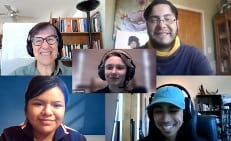
As Dr. Melissa Beresford notes (pictured left) “ What the COVID-19 pandemic has done is it’s just put a giant magnifying glass on all of the existing inequalities that were already in our society, and it’s just kind of magnified, what those inequalities are, and exacerbated those inequalities for sure.”

Adaptation and Collaboration

Applied and public anthropologists at San José State systematically adapted our research and community work to:

  • Identify and overcome obstacles
  • Adapt research methods
  • Retool our analytical toolkits to better understand and communicate the impact of the pandemic

Dr. Beresford clarifies, “So recruitment is really challenging, based on the COVID -19 pandemic, especially recruitment for hidden populations. So what we did to get around that is, we partnered with CommUniverCity San Jose, since they have long standing ties within communities in San Jose, and devised a kind of a virtual recruitment survey.”

Publishing takes a long time, so it was important to get thoughts into the world quickly.  Drs. Marlovits and Gonzalez published an article in Anthropology Today early in the pandemic that framed the emerging experience for a broader audience. As Gonzalez comments,

We were both using the opportunity to try to give a sense of what we were feeling. But also trying to give an anthropological view on how the virus, how the pandemic, was really kind of breaking open these inequalities and these problems, these deep social problems that are often hidden in Silicon Valley and the Bay Area more generally.

Others, barred by circumstance from collecting new information, used the moment to reflect, write, and publish.  Dr. Meniketti comments, in reference to his work in historic archaeology:

So the research was conducted earlier, the pandemic simply enabled me to bring it to publication. I’m editing, I’m working. I’m working on an edited book right now with multiple authors. And essentially, they’ve all said to me, oh, they’ve got time. They can do a chapter for me because they can’t get in the field, they can’t do anything else. So, they’re more than happy to contribute a chapter… They’re just using this as an opportunity to publish that work.”

Our applied anthropological community created collaborative partnerships to amplify the efforts that any one of us could make alone.  We found that people could:

  • Use the moment to experiment with new directions and tools
  • Explore emerging phenomena
  • Collaborate within and across institutions and stakeholders
  • Build research opportunities between professors, professors and students, academia and communities of practice

Dr. Faas used his existing network in disaster anthropology to build a collective.  He comments,

We started thinking about what are the important questions to ask. Not, ‘Hey, we’ve done this before we have all the answers.’ It was based on our work in the past. What are the types of questions we have to ask? And then, I worked with my colleagues in this collective known as CADAN…, which is the Culture and Disasters Action Network… It’s a collective that has been funded multiple times by the National Science Foundation, to work with non-academic practitioners around disasters to develop research-based solutions to really abiding problems in the world of disasters.

Dr. Faas and Dr. Beresford collaborated on data collected by Dr. Faas’ students on pandemic experiences.  Faas and his students collected the data and Beresford and her students analyzed it.  Similar collaborations were taking place in seminars and classes throughout the Anthropology department.

Community

Meanwhile, our alumni in applied anthropology were meeting the moment through their professional work.  Many were working in research, non-profit, or governmental organizations serving communities radically disrupted by the pandemic.  They found new strategies to:

  • Build community with common purposes
  • Seek opportunities to refine and redefine relationships
  • Create more inclusive approaches in their organizations

Maribel Martinez work (shown left being interviewed by Abril Perez- Gonzaga) shifted from her duties with Santa Clara County’s LGBTQ communities to engaging with Spanish-speaking people about the pandemic, drawing on her own Master’s work with SOMOS Mayfair.  She says,

“The other forms of engagement that the county has used have also been more intensified in terms of community outreach. We have partnered with community organizations, such as community health workers, and those who use the promotora model to make sure that our information is going out into the community.”

The experience of work has changed within the County. She adds,

A lot of the work before had been dependent on people being physically in an office or on the job site. Now, because we’ve been doing remote work for over a year, some departments, some of us still come in every day. But some departments have been staffed exclusively by remote work, that it’ll be something that is going to be ingrained into our organizational culture on having those virtual workspaces as well.

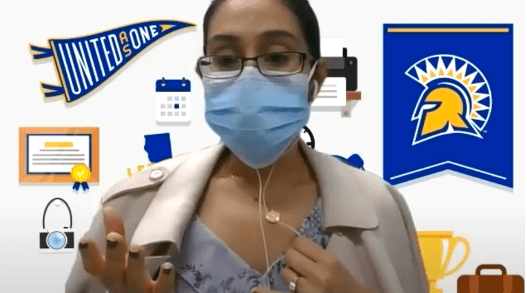
Mayra Cerda, (shown above) working with Sacred Heart, amplifies the challenge this poses in working with communities.  She reflects,

Like the Flintstones, we just did everything on paper, on the rocks. And we needed to implement something more advanced like the Jetsons. Right? —like the cartoons. Let’s find out a good software that we can use like Salesforce, in which the application can go through Salesforce, and we can calculate the amount that they will be getting, and to see if they’re qualified. So, everything was like going backwards, like moving fast. In a second. It was very crazy.

 Alumna Hannah Hart applies her anthropological skills as an instructional designer, working on ed tech UX.  She notes, “I think parents and teachers and districts have realized there is […] a limit to how much learning students can do online and we got to be creative in order to make things like that possible in the future.” Hannah also reflects, “But I think parents and teachers and districts have realized there is […] a limit to how much learning students can do online and we got to be creative in order to make things like that possible in the future.”

Students themselves have found connections to get them through jump into the digital learning environment.  Nick Marichione (shown left), an athlete and international undergraduate, is working with Drs. Faas and Beresford to understand the social support systems that students inhabit and create.  He reflects on the communities he has observed and suggests, “Some communities have thrived.” He goes on to add “it sort of made you understand who’s important in your life, and what aspects you need.”

Implications for the Future

The Covid-19 pandemic magnified existing social inequalities in our environment and the discipline of anthropology plays a crucial role in situating and addressing these challenges. Dr. William Reckmeyer, a systems scientist, and emeritus faculty member with a 40-year career in our department, provided us with some insight on how to address major challenges. During his interview, he explained to us the Law of Requisite variety.

One of the things we know from systems science is that if you’re engaging in any kind of complex challenge, you need to have more variety. It’s called the law of requisite variety …it basically says… if you’re not capable of exhibiting as much variety as whatever’s challenging you, you can’t overcome it.

Two basic strategies to overcome complex problems are to dampen external variety or amplify our own. While Covid-19 has brought a magnifying glass to issues and inequalities, it has also highlighted our ability and need to collaborate and communicate with one another. From our departmental community’s oral history, we found that our students, faculty, and practitioners adapted in a variety of innovative ways. Applied anthropologists from San Jose State University collaborated and cultivated a variety of perspectives to meet the challenge.


Gen Z + Y and COVID-19: How Are Growing?

Project Investigators: Shelbie Taylor, Chiara Cecchini, Andoeni Ruezga, Virginia Cipollina

Project Sponsor: Dr. Jan English-Lueck

This project was done in partnership with Future Food Institute, an Italian and global-minded non-profit organization concerned with food sustainability and innovation. In light of the global COVID-19 pandemic, this project was proposed to investigate how Gen Z and Millennials’ food purchasing habit might be impacted. This study involved interviewing a wide variety of participants across Europe and the United States, including SJSU graduate and undergraduate students about their “new normal.” Participants shared their stories about how COVID-19 has impacted their daily lives – including how lockdown measures affect their mental, physical, and emotional health, financial well-being, and their relationships and community ties. The researchers and participants also discussed how their eating and food acquisition habits have changed over the course of quarantine. These shifts in food habits can provide the Future Food Network with insights for improved sustainability practices for food providers and initiatives to reduce food waste on a global scale.