
Action Alert: Urge Your Senators to Support the FY2015 NSF Funding Bill

Action Alert: Ask your senators to support the FY2015 NSF Funding Bill.

I will be using this blog to keep you up to date on good times to contact your legislators to urge their support for relevant bills, especially related to science funding. The budget process stretches from February, when the President submits a budget request, to September, when Congress hopefully passes a budget for the fiscal year beginning in October. Of the ~$3.8 T in federal spending every year, 2/3 of the spending is mandatory funding for things like Medicaid, Social Security and paying off the national debt. Of the remaining discretionary spending, over half goes to defense ($728 B). Most of the debate rages around the non-defense discretionary spending pool ($535 B), which includes funding for scientific research. There are many points during budget negotiations where advocacy can be effective in maintaining favorable science funding levels. If you are interested in more detail about the budget process, I suggest the Society for Neuroscience webinar section: The Federal Budget Process.

This week the Senate is debating the fiscal year (FY 2015) Commerce, Justice, Science (CJS) Appropriations bill (HR 4660) that funds the National Science Foundation (NSF), National Oceanic and Atmospheric Administration (NOAA) and the US Department of Agriculture (USDA). This bill would provide $7.255 B in funding for NSF, an increase of $83 M (1.2%) above the current level and allow the funding of an additional 140 competitive grants from NSF. The Senate bill would also increase funding for NOAA by $105 M and the USDA would receive an additional $17 M for intramural research and an additional $8.5 M for extramural research. While the bill did leave the Senate Appropriations Committee with bipartisan support, Senators are allowed to add amendments. It is expected that amendments decreasing social science funding are likely. For more on this bill, see here.

You can show your support for increased funding for research at NSF, NOAA and USDA by contacting your senators (in CA our Senators are Barbara Boxer and Dianne Feinstein). Many organizations have easy email forms to fill out, but it often helps to personalize your letter or phone call with information about how this funding will affect you, your lab and/or your students. You can use this site to find out who your legislators are at all levels.

The State of Science Funding in the US: Is it really that bad?

It seems like every week a new opinion piece is published about the potentially disastrous effects of cutting the budget for scientific research. Most scientists, myself included, have stories of friends who left academic research discouraged by the budget situation or know of established labs that have had to lay off technicians or postdocs after losing funding. Even the NIH Director Francis Collins is singing the blues.  But the government invests billions of dollars in research funding every year, so can the state of science funding in the US really be that bad? After looking at the evidence, I am convinced that yes, it really is that bad and that we as scientists need to do a better job of communicating to our elected officials and the public the value of investing in science.

How Has Science Funding Changed Over Time?

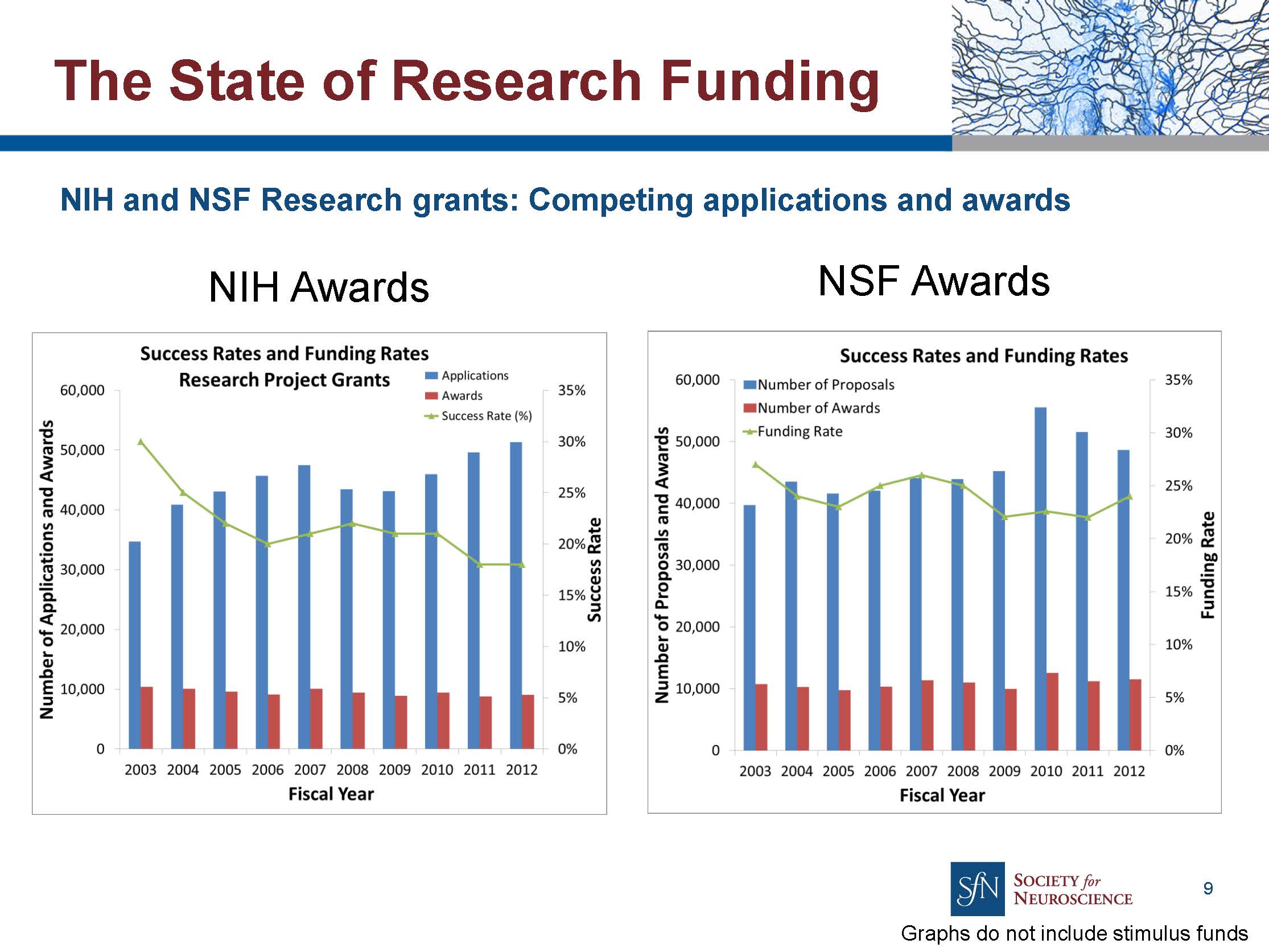
The NIH budget was doubled over a 5 year period (1998-2003), and since then funding has remained flat in real dollars but decreased by ~20% if you account for biomedical inflation. NSF Funding since 2003 has shown a similar trend (1). NIH’s FY 2014 Budget is $30.15 B, an increase of $1B over the first year of the sequester (FY 2013), but still lower than the FY 2009 budget. Together, NIH and NSF receive ~$37B in funding or less than 2% of the federal budget.

NIHNSFSuccess_Page_07

What Do We Get For Our Investment in Science Research?

The list of advances that have been at least partially funded by federal money is too long to list here. Federally funded research has laid the groundwork for advances in medical treatments (polio vaccine, chemotherapy, antiretroviral AIDS drugs; 2) and the development of technologies that we take for granted (Google search engine, GPS, solar panels 3). If you were offered the opportunity to buy a stock with the return on investment that federal science funding generates you would be a fool not to buy it. It is estimated that every $1 invested in the NIH generates $2.21 in economic activity (and here in CA that number is estimated to be $2.40; 4). Similarly, every $1 invested in NSF is estimated to generate $2 in economic activity (5). NIH and NSF also support students and trainees at all levels, including the MARC, RISE, LSAMP and RUMBA programs here at SJSU.

How Have Grant Success Rates Changed Over Time?

As funding levels and the number of awards have remained flat since 2003 and the number of applications has increased, the percentage of grants funded have decreased. Success rates for NIH R01 grants have plummeted from ~30% in 2003 to the historic low level of 17.5% in 2013 (1, 6). Success rates for first time applicants to NSF fell from 22% in 2000 to 15% in 2006 (7). With falling success rates, investigators need to submit more grants in order to remain funded–NSF estimates that an increase in proposal number of 30% from 2000 levels was needed to receive the same number of awards in 2006 (7). It is hard to find a good quantification of how much time researchers spend applying to grants instead of conducting research, but an Australian study estimated that each proposal took ~34 working days to write and cost the country ~ AU$66M in salary (8).

NIHNSFSuccess_Page_09

Bottom Line: The past decade has seen a drop in federal investment in scientific research, even though the economic return on investment is about $2 for every $1 spent in addition to the knowledge, technologies and treatments the research produces. Decreased funding has led to falling success rates for grants and uncertainty about the future for researchers. It is hard to predict the full effect of these cuts in terms of delayed medical advances or the loss of talented scientists.

Welcome to the SJSU Science Policy Blog!

Some quick FAQs about this blog to start things off:

What is the purpose of this blog?

This blog will be used to keep the SJSU community updated on issues related to science policy, including information about relevant legislation and tips for how you could get involved in advocacy if you wish. Hopefully reading this blog will serve as an easy way for you to stay informed on science policy without taking too much time out of your busy day (or adding more emails into your already clogged inbox).

Who is writing this blog?

For now, Katie Wilkinson an Assistant Professor of Biological Science and 2014 Society for Neuroscience Early Career Policy Fellow will be updating the blog. If you would like to share your experiences in advocacy, inform the SJSU community about pending legislation, or in any other way contribute as a guest or co-blogger please contact Katie at katherine.wilkinson@sjsu.edu.

Why did you decide to write this blog?

Like many people I often find myself exasperated at some of the decisions made in Washington–obviously funding science is worthwhile and our policies should be informed by science! Just assuming that legislators should know this is not really fair, though. Part of their job is to listen to what their constituents have to say and part of our job is to keep them informed. When the sequester slashed the Minority Access to Research Careers (MARC) Program budget at SJSU by over 50%, I called my elected officials (as did a few MARC students). Surprisingly (to me) the aide I spoke to at Representative Honda’s office was very interested in the issue and wanted to set up a time for Rep. Honda to come to SJSU and meet with students in the MARC program (a future blog post will discuss this visit, but for now you can learn more here).  As a Biology Department alumnus and former science teacher, Rep. Honda didn’t need too much convincing that the MARC program was important. I wish I could say that after that meeting the cuts were restored, but of course that is not how things work. This experience did cause me to want to learn more about how to advocate for things like increased science funding and I decided to apply for SfN’s Early Career Policy Fellowship. As a fellow I have received training in the legislative process and advocacy. I also participated in SfN’s Hill Day this March. For the rest of the year I have been tasked with helping to educate my colleagues about science policy and advocacy, which is why I have started this blog.

Where can I find information about issues relevant to my particular discipline?

Some of the information I post will be pertinent to all fields of science, but since my research is biomedical that area will get a disproportionate share of the attention. If you want to keep up to date with issues more directly related to your field of study most professional societies have advocacy action sites, advocacy newsletters and probably host Hill Days and/or fellowships similar to the one that I did with the SfN.  For example, I subscribe to both SfN and the American Physiological Society’s email blasts.