Talk to Your Friends and Family About Science: Ebola Edition

This weekend my grandmother asked me if I had heard that two American aid workers with Ebola were being treated at Emory University. To be fair to my grandmother, I didn’t wait to see if she was worried about Ebola spreading in the US or just brought it up since she knew I did my postdoc at Emory. Instead I immediately replied, that yes I had heard they had been taken to Emory and that I was sure the doctors and nurses at Emory were in a very good position to treat them safely. I also told her that Ebola is relatively difficult to catch as you have to be exposed to bodily fluids from an infected patient.

This conversation illustrates a really important science advocacy role that we should all be playing: helping to inform the public (and especially those closest to us) about science and how to find reliable sources of information. There is a lot of misinformation about Ebola swirling around and we need to find some way to make sure the real science is heard over all the fear mongering.

Here are some great resources on Ebola to share with your family and friends:

“Please don’t panic about Ebola, here’s what you need to know” by Danielle N. Lee — Short and very accessible article appropriate for everyone.

“Everything you know about Ebola is Wrong” by Tara C. Smith — 5 Ebola myths debunked. Other posts on the author’s Aetiology site are also quite informative and go a bit more in depth about some of the background science.

Of course, communicating science isn’t always easy…

EbolaTwitter

Image from Twitter user @emmkaff


Action Alert: Adjunct Faculty Loan Forgiveness Act Introduced

On Thursday, Senator Richard Durbin introduced the Adjunct Faculty Loan Forgiveness Act which would allow part-time adjunct faculty to access the Public Service Loan Forgiveness Program (PSLFP). The PSLFP provides educational loan forgiveness following 120 on time monthly payments made while employed full time in a public service job (which includes jobs at federal, state, and local governments and tax-exempt non-profits). Currently you must work at least 30 hrs a week for the entire year to have your payments qualify, which makes many part-time adjunct faculty ineligible. The new bill would allow adjunct faculty to be eligible for the PSLFP as long as they teach at least 1 course per year and do not hold a full-time non-public service job.

Actions you can take to support the Adjunct Faculty Loan Forgiveness Act:

As with any bill you support, calling or emailing your legislators is a good first step. This bill was referred to the Senate Committee on Health, Education, Labor and Pensions, so it is especially important to contact your Senator if they are on that committee (list of members can be found here. No CA Senators are members of the committee).

If you want to learn more about the bill, you can join a call with Senator Durbin and the Adjunct Action Network on August 5th.

Female Lab Rats Are Also Underrepresented in Science

Women have been traditionally underrepresented in science not only as scientists, but also as experimental subjects. This lack of representation in both clinical trials (especially before the 1993 NIH Revitalization Act that required the inclusion of women and minorities in clinical trials)  and preclinical basic research has had negative consequences for women’s health. There are well appreciated sex differences in the basic physiology and prevalence rates of many diseases. Even though cardiovascular disease is the most common cause of death in women, only 1/3 of the subjects in clinical trials on cardiovascular disease are women and less than 1/3 of those trials report the results by sex, meaning they may miss treatments that are promising for one sex but not the other. Women are more likely to suffer from a chronic pain condition than men and even though there is evidence of multiple sex specific pain pathways, 79% of animal studies in the journal Pain from 1996-2005 only used male animals. Sex differences in metabolism can mean that a dose that is effective in men is harmful in women, likely one of the reasons that women experience more side effects than men and that 8 of 10 drugs recently recalled by the FDA led to more serious adverse reactions in women.

Lately the under-representation of female subjects has been getting more attention. In April of this year, a group of senators requested a Government Accountability Office investigation into whether NIH funded clinical trials  included appropriate analyses to determine if there were sex differences in the response to treatment. In March a National Policy Summit on the Future of Women’s Health and accompanying report highlighted both the advances in women’s health research since the 1993 NIH Revitalization Act and the many remaining areas of inequality in clinical research.  The NIH recently announced plans to require that preclinical research on animal models and cell lines include subjects of both sexes, unless there is scientific justification for a single sex study (these guidelines will be phased in starting October 2014). The Research For All Act introduced in June by Rep. Jim Cooper and Rep. Cynthia Lummis would require the NIH to have guidelines for the inclusion of both sexes in preclinical research (in all cases except those which the NIH director deems unnecessary). This law would also require expedited clinical trials to include enough participants to test the efficacy and safety of the treatment in both sexes and for the NIH to report demographic information in their biennial report.

The new NIH guidelines attempt to address the huge bias in neuroscience, physiology and pharmacology studies to include only male animals or not to report the sex of the animals at all. A common justification for not including female subjects is a potential increase in variability that is caused by the estrous cycle (which would require monitoring of estrous cycle and subject groups for each stage of estrous). Recent meta-analyses have found similar variability in both sexes in response to a variety of pain tests and  behavioral, molecular and physiological tests in neuroscience,  suggesting that monitoring estrous cycle is unnecessary and that female mice are ‘now liberated for inclusion in neuroscience and biomedical research‘. There has been push back in the scientific community, though, with some arguing that the new guidelines will lead to a huge increase in research costs and time. Since NIH funding levels have stagnated in recent years, this is a cause for concern. It is unclear what will be considered sufficient justification for only studying one sex and whether additional resources will be available. For health issues where there are known sex differences or ones that disproportionately affect women, it is just good science to include female subjects, though.

Since the Research for All Act would require sex balance in NIH funded research, now would be a good time to express your opinions on these guidelines to your elected officials — and of course to remind them of the importance of federal funding in developing treatments for both men and women (to find your elected officials click here). Personally, I think an increased emphasis on the fact that sex is an important biological variable is a good thing, though I would like to hope that the scientific community could be persuaded to do this without a legal imperative. (Full disclosure: my lab is currently looking at both male and female animals, so I don’t have to change my research program and as a woman I have a vested interest in ensuring that treatments are tested in women)


A Hole in the Female STEM Pipeline: Elite Labs Run by Male Professors Train Fewer Women

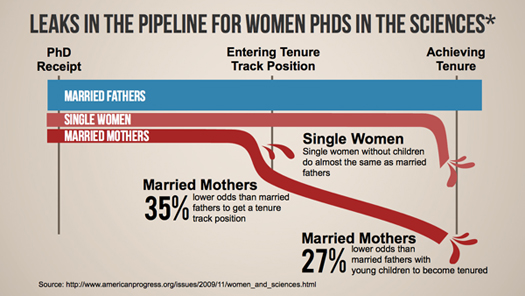
The percentage of PhDs in Biology awarded to women has increased from only 15% in 1969 to 52% in 2009. Even with these dramatic gains in the number of female PhDs, women currently make up only 36% of assistant professors and 18% of full professors (1). This drop-off in female representation after graduate school is often termed the ‘leaky pipeline’ and has far-reaching consequences for the state of science and our economy.
thumb-pipeline_sci

Figure from Tools for Change

A recent article in PNAS details one hole in the academic pipeline for women: elite labs run by male, but not female, professors are less likely to train female graduate students and postdocs. Labs were qualified as elite if the PI was awarded Howard Hughes Medical Institute (HHMI) support, a member of the National Academy of Science (NAS), or had won a major award like the Nobel Prize. Labs headed by men had fewer female graduate students (47%) and postdocs (36%) than labs headed by women (53% and 46% respectively), but in elite labs run by male professors, female trainees were even more poorly represented. In contrast, the gender makeup in labs headed by women was unchanged with elite status. The authors found that men were 25% more likely to complete their postdoctoral work in the lab of a NAS member and 90% more likely to postdoc in the lab of a Nobel Laureate. Women win graduate and postdoctoral fellowships at rates proportional to their representation in the applicant pool, suggesting that female trainees are as qualified male trainees. The reason why this deficit matters is that assistant professors in research universities are likely to come from elite laboratories (see full article here).

Why elite labs train fewer women was not determined in this study, but most studies on the leaky pipeline tend to focus on two areas: implicit bias and the lack of family friendly policies. While the days of women being explicitly barred from pursuing certain careers are over, implicit bias against women is still alive and well. When given identical resumes, both male and female PIs were more likely to rate male candidates favorably, choose higher starting salaries for male candidates and offer male candidates more career mentoring (2). In European countries where tenure committees are randomly assigned, female candidates are less likely to receive tenure if their review committee is all male but receive tenure at similar rates as men if they have a mixed review committee (1). In a recent survey, 16% of female scientists report instances of sexual harassment in the workplace and this harassment can have far-reaching consequences as vividly illustrated with the #ripples of doubt twitter conversation. It is well known that certain labs are more family friendly than others and female postdocs are more likely to take that into consideration when choosing a lab. Women who have children during their postdocs are much more likely to decide against a research career than male postdocs with children, whereas female postdocs with no plans of having children are as likely to choose a research career as male postdocs with or without children (3).

What Can We Do To Plug the Leaks?

Recruiting and maintaining a diverse scientific workforce is something we all will benefit from (and much of what I’ve discussed here also applies to other groups traditionally underrepresented in science). This is an area of science policy that needs to be tackled at all levels. Locally, we can try to acknowledge and overcome our biases in our laboratory and department hiring and mentoring. If you are on a conference organizing committee, help to recruit female speakers and work to provide child care arrangements, especially paid options for graduate students. Institutionally we can work to implement family friendly policies, like those instituted by UC Berkeley’s Faculty Family Friendly Edge Program (you can even use this cost simulator to see the true cost of not implementing these policies at your institution). At the federal funding level, we can advocate for the expansion of programs like the NSF’s Career-Life Balance supplement that provides funds for a technician while the PI is on maternity leave. 

In this short post I’ve only scratched the surface of these issues. Below are some suggested sites if you want to learn more:

Tools for Change in STEM

Nature Special Edition on Women in STEM

STEM Women 

The UC Faculty Friendly Edge

UC Davis ADVANCE

Old Boys’ Lab–nice write-up about the PNAS study by AAAS Mass Media Fellow Jane Hu

A Fun Way to Show the Value of Basic Science Research

Want a 4 minute explanation of the value of basic science research? Check out the winner of  the Stand Up for Science Video Contest sponsored by the Federation of American Societies for Experimental Biology (FASEB). It is important to remember that so many of the biggest achievements in modern medicine came about as side effects from research on a completely different topic. When asked whether the government should fund the development of a new treatment for diabetes or a study on how bacteria defend themselves, most people will choose the diabetes treatment. As the video clearly points out, though, studying how bacteria defend themselves has led to unexpected advances in many fields, including the treatment of diabetes. So next time you hear someone scoff at funding research on fruit flies, bear DNA, or duck genitalia, send them a link to this video.

StandUpForScience

Screen shot from ‘Funding Basic Science to Revolutionize Medicine’

You should also check out the other award winners for some fun facts on science funding – like the fact that life expectancy of an HIV+ person has increased from a few months in the 1980s to 50+ years now.