
2024 SJSU Engineering Showcase Recap
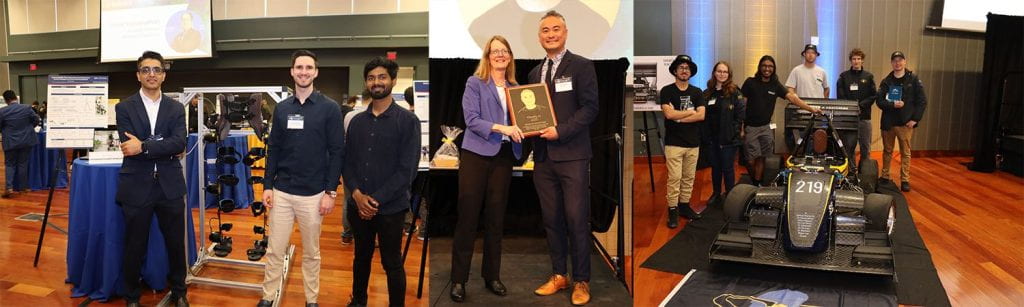
On Monday, April 15, the College of Engineering (CoE) held its annual Showcase where alumni and industry friends engaged with the next generation of talent, innovation, research, and designs. The Showcase event was a part of SJSU’s Research Week 2024, which ends on Friday, April 18. The focus of the CoE event was on fostering connections and highlighting the amazing projects students have been working on.
On display at the event were: algorithms for self-forming DNA meshes, facial recognition models for identifying various types of autism, materials used to create a buoyant cement canoe, quantum computing, stackable cube clusters for personal cloud storage, urban forestry data collection, smart farming monitoring, and so much more.
The Spartan SR-14 electric car won as the most engaging project, and the Mechatronics and Control System Design of a Bimanual Hand Exoskeleton with a Sensorized Soft Glove captured the most innovative category win. Both of these projects fall under the Mechanical Engineering department umbrella. Congratulations to both teams!
Alumni and friend of the CoE, Tim Li, received the award of distinction which recognizes an individual who has achieved superior professional accomplishments and applauds the recipient’s outstanding citizenship through community or professional service. Well done, Tim!
A huge thank you to the sponsors: The Beall Family Foundation, San Jose Water, and Salas O’Brien for their contributions and commitment to the College of Engineering that made the 2024 Showcase possible!
Diversity Month
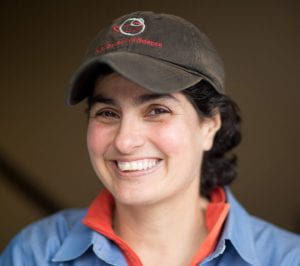
Image courtesy of MIT, Department of Physics
Nergis Mavalvala’s journey to Cambridge University speaks volumes of perseverance, passion, and the pursuit of knowledge. As a Pakistani-American astrophysicist, Mavalvala’s groundbreaking work in the detection of gravitational waves has earned her international acclaim.
Born and raised in Pakistan, Mavalvala’s early years were shaped by a curiosity about the cosmos. Educated at the Convent of Jesus and Mary, she pursued her passion for physics and astronomy at Wellesley College in the United States, under the mentorship of Rainer Weiss at MIT.
Mavalvala’s contribution to the Laser Interferometer Gravitational-Wave Observatory (LIGO) project revolutionized our understanding of the universe and helped engineers to develop spacing equipment better. Over two decades, her relentless efforts led to the historic observation of gravitational waves in 2015, when two black holes collided, confirming Einstein’s theory of relativity, which proposes that gravity arises from the curvature of spacetime.
Perhaps equally as remarkable as her scientific achievements is Mavalvala’s advocacy for academic and inclusion in STEM fields. As an openly queer woman of Pakistani descent, she has shattered stereotypes and defied societal expectations, serving as a role model for aspiring scientists from underrepresented backgrounds. Mavalvala stated, “I grew up in a family where the stereotypical gender roles were not really observed. So I grew up thinking women can, must, and should do anything and everything.” She also believes that access to education is how you can find who you are, do what you love, and contribute to society anywhere in the world for anyone.
Mavalvala’s impact extends far beyond the laboratory. Today as the Dean of MIT’s School of Science, she is dedicated to fostering an environment where all individuals, regardless of background or identity, can thrive and succeed. Her commitment to mentorship and advocacy has inspired countless students and researchers to pursue their passions.
In a world where scientific progress thrives on diversity, Mavalvala stands as a symbol, reminding us of the transformative power of inclusion. As we celebrate her achievements, let’s remember that embracing diverse perspectives is key to unlocking new dimensions in science and engineering.
5 Questions with Author, Educator, and Influencer Ahmed Banafa
 Discover Prof. Ahmed Banafa’s insightful perspective on the current state of artificial intelligence and its ethical considerations. From addressing bias and fairness to envisioning the impact on the future job market, he provides comprehensive insights into AI’s challenges and opportunities, from recommendations for minimizing bias in AI algorithms, to effectively integrating AI into education. Professor Banafa offers a roadmap for navigating AI technology’s complex landscape. Read the full article now.