November 2017 Newsletter: ERFA Grants Support Current SJSU Researchers

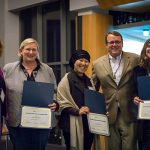
Photo: James Tensuan Anthropology Assistant Professor AJ Faas and Social Work Assistant Professor Nicole Dubus received the 2016-17 Emeritus and Retired Faculty Association Faculty Research and Creative Activity Awards. Applications for 2017-18 are due Dec. 6.

Photo: James Tensuan
Anthropology Assistant Professor AJ Faas and Social Work Assistant Professor Nicole Dubus received the 2016-17 Emeritus and Retired Faculty Association Faculty Research and Creative Activity Awards. Applications for 2017-18 are due Dec. 6.

By David Goll

Research by San Jose State University professors into how societies and nations respond to and cope with manmade and environmental disasters – and what happens to individuals when they flee due to war, political instability or climate change – received support from the Emeritus and Retired Faculty Association (ERFA) in 2016-17.

The association of former professors is now welcoming applications for the SJSU ERFA Faculty Research and Creative Activity Award, due December 6. The two grants of up to $2,500 per person are awarded to tenured faculty, tenure-track faculty or lecturers with more than six years of continuous service to San Jose State.

“Four years ago, we had some additional money,” said Joan Merdinger, member of ERFA, which includes more than 300 former SJSU faculty members. “In the past, we made donations to the library, to faculty, to the deans to use in a discretionary fashion. We wanted to do something ongoing, to honor the mission of service to the university.”

Merdinger, who retired from SJSU after a 26-year career as a professor in the School of Social Work and a stint as Associate Vice President for Faculty Affairs, said the modest grants can help faculty members attend important conferences, or help secure the assistance of graduate students in conducting research.

The resulting awards program has benefitted six current faculty members to date, including the most recent recipients: Dr. Nicole Dubus, assistant professor in the School of Social Work, in the College of Applied Sciences and Arts; and Dr. AJ Faas, assistant professor in the Department of Anthropology, in the College of Social Science.

Dubus conducts research into a compelling global issue: how public agencies can cope with the worldwide epidemic of forcibly displaced people, who number 65.6 million, according to the United Nations Refugee Agency. Examining how other countries, primarily in Europe, are dealing with waves of humans fleeing war, repression and political upheaval in Africa, the Middle East and other regions, Dubus said she hopes to bring some of the strategies being employed overseas to local communities and possibly incorporate them into the curriculum at SJSU.

In July, Dubus traveled to Malta, a tiny island nation in the Mediterranean Sea with 383,000 residents situated between North Africa and Italy. It has received thousands of forced migrants and asylum seekers in the past 15 years. While there, she studied the various stages of processing and assimilation of migrants and refugees from African and Middle Eastern countries who land in this first foothold of Europe, including how they gain access to healthcare and other public services.

Dubus met with Carmel Cefai, associate professor in the University of Malta’s Department of Psychology, director of the Centre for Resilience and Socio-Economic Health and a leading advocate for the concept of social and emotional resiliency among children, teenagers and young adults – including migrants trying to make successful transitions to a new society.

She would like to see that resiliency concept adopted locally as San Jose and other Bay Area cities struggle to assimilate adults and children fleeing dire social, political and economic circumstances. Dubus said she has also conducted research into how migrants and refugees are treated in Iceland, Germany and Sweden, having received grants from the National Science Foundation.

“I was able to spend two weeks in Malta and had a fantastic experience. I would not have been able to make the trip had it not been for the (ERFA) grant,” she said.

The $2,500 grant also proved instrumental for Faas to visit Bogota, Colombia this past June. Faas has been a member of the San Jose State faculty since 2014. He was invited to attend a meeting of 14 anthropologists, mostly from Latin America, by Virginia Garcia-Acosta, a prominent Mexican historian and social anthropologist. The group is collaborating on a book detailing the anthropological history of disasters throughout Latin America, including such watershed events as the 1985 Mexico City earthquake that killed 10,000 people, injured 30,000 and left thousands more homeless.

Faas’s academic research specialty is focused a bit further south in Ecuador, a nation of 12.5 million located along the west coast of South America. It provides no shortage of research opportunities for Faas, who began visiting the country regularly in 2009. His research includes an ongoing study of recovery and resettlement of Ecuadorean highlands residents as a result of volcanic activity.

“This is a country with 30 (mainland) volcanoes and close proximity to El Nino,” he said, referring to the meteorological phenomenon known officially as the El Nino Southern Oscillation that periodically develops in the Pacific Ocean and can lead to tremendous volumes of rain falling in some parts of the Americas.

He said that along with the disasters, Ecuadoreans have also had to cope with tremendous social and political upheaval, including adapting to 10 different presidents during a 14-year stretch between 1991 and 2005.

During his South American visit this past summer, Faas, also a member of the worldwide Culture and Disasters Action Network, said he was able to interview a number of Andean scholars for his research.

ERFA’s Merdinger said, as in past years, applications from the next group of grant proposals will be reviewed by members of the organization’s board of directors. For more information about the grant program, see application online.
November 2017 Newsletter: Staff Gain Skills Through Professional Development Grant Program

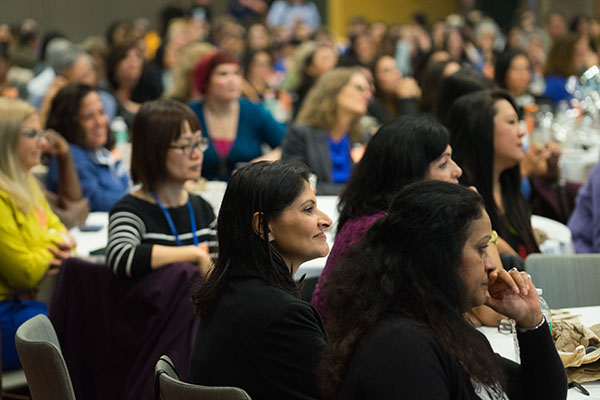
Provost Andy Feinstein and the Academic Affairs Leadership team host an appreciation breakfast to say thanks to the 500+ staff members who support faculty and students in the division. (Photo: James Tensuan, '15 Journalism)

Provost Andy Feinstein and the Academic Affairs Leadership team host an appreciation breakfast to say thanks to the 500+ staff members who support faculty and students in the division. (Photo: James Tensuan, ’15 Journalism)

By David Goll

Whether they traveled across the country, 60 miles up the road — or never left their desks — employees in Academic Affairs made the most of the Staff Professional Development Grant program in 2017.

During the 2016-17 academic year, Academic Affairs Division awarded more than 50 such grants to staff members, which can range up to $1,500 for an individual or $5,000 for a group proposal. Designed to promote employees’ professional development and enhance effectiveness, the grants are primarily used to participate in training programs, in-service activities and team-building exercises, or to attend conferences and staff retreats.

April Gilbert, Institutional Repository Coordinator for the Dr. Martin Luther King Jr. Library at SJSU was one of those who traveled cross country. In March, she used her $1,405 grant to attend the biennial Association of College and Research Libraries National Conference held in Baltimore.

“It was a very valuable experience,” Gilbert said. “It’s a great place to find out about best practices in the industry; how to deliver better services and create better work flows; how to help researchers produce, publish and disseminate their work; how to better communicate with your faculty.”

Gilbert said she was especially interested in speaking with librarians from other universities nationwide to get additional ideas on how to promote her library’s collections, attract more people to use them, as well as how to encourage more SJSU faculty members to utilize the material in their own classes. Gilbert said she works closely with Emily Chan, interim associate dean for Research and Scholarship at the university’s library, to accomplish those goals.

“This conference was really great,” Gilbert said. “And I wouldn’t have been able to attend without the grant. It definitely made the trip possible.”

Lin Sao’s professional growth opportunity was a bit closer to home. Sao, who works as an academic advisor for undergraduate business students at the Jack Holland Student Success Center, received about $400 through the program to attend the annual conference of Asian Pacific Americans in Higher Education, a 30-year-old organization that champions the success of Asian Pacific American college and university students, staff, faculty and administrators. Sao attended the April event held in Oakland.

“This is an organization helping students of Asian and Pacific Islander descent deal with the struggles and challenges facing them in higher education,” said Sao, who previously worked as an admissions communications counselor at SJSU. “At the conference, I learned about new and interesting ways to aggregate data on the Asian Pacific Islander student population. Asians may appear to be doing well when ethnic data is not disaggregated, but that’s not necessarily true of all Asian populations. Some Asian ethnicities such as Southeast Asians struggle in a college environment.”

Dave Daley’s grant-fueled travels were a bit further away. In January, he traveled to Las Vegas to attend the annual Consumer Electronics Show to get the latest on cutting-edge technology for possible application at SJSU. The Information Technology Analyst at the SJSU library used his $1,500 grant to attend the sprawling electronics industry extravaganza — centered on the Las Vegas Convention Center — but held at venues all over the city. The library covered the gap for his $1,711 trip.

“CES is a great place to go to find out about state of the art, cutting-edge technology,” said Daley, a 14-year employee of SJSU. “IT is usually the department frequently viewed by other departments as the place to go for new ideas.”

Daley said the panel discussions at the show can be just as helpful and informative as checking out the latest products being displayed by tech companies. He was particularly intrigued by industry representatives discussing the possibilities for 5G — or fifth-generation wireless systems — that, unlike current 4G technology, promise to operate at real-time speed, no delays and be fast enough to accommodate high-resolution videos on cell phones, he said.

“There are no (5G) products yet, but it’s so important to hear about the latest technology, and see what manufacturers are working on,” Daley said. “It’s good to hear the latest straight from the horse’s mouth.”

Daley’s colleague, Klaus Trilck, didn’t have to travel anywhere to participate in the intensive, two-day online presentation known as the Educause Learning Initiative. Educause is a Colorado-based nonprofit collaboration of colleges and universities that promote advances in education through the application of innovative technology. He received $400 through the staff grant program.

“Technology changes so rapidly it’s important for me to keep abreast of it. The students certainly do,” said Trilck, an eCampus instructional designer since January who has worked at SJSU for five years. His job is to help faculty members develop creative and relevant classroom presentations. “Participating in Educause helps me keep pace with hardware and software development.”

Trilck said he found the Educause online presentation helpful and informative through its dozen or so speakers and interactive format that allowed Web participants to ask questions in real time.

“This is very effective for professional and personal development,” he said. “And it keeps me active and viable as a university employee.”

Author and Artist Awards Celebrate New Publications, Pieces and Performances

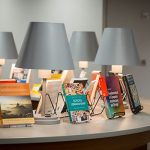
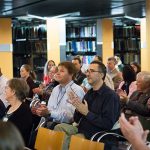
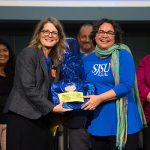
The Author and Artist Awards on Nov. 3 celebrated the work of 39 Spartans who completed significant publications or performances in 2017. The evening event this year was held in the Dr. Martin Luther King Junior Grand Reading Room on the eighth floor with President Mary Papazian offering opening remarks while Provost Andy Feinstein shared some closing thoughts. The annual campus event sponsored by the Office of the Provost, Office of Research, Spartan Bookstore and University Library is designed to recognize faculty and staff who have recently published a book or other major works of general interest and significance.

“As I shared in my fall welcome address, amazing things happen when liberal arts and STEM connect,” Papazian said at the event. “That is evident in the publications we celebrate today with an anthropologist who studies Silicon Valley culture, a librarian who provides a guide to massive open online courses and a composer who uses computers to make music. The work you do that leads to these publications exposes our students to research, scholarship and creative activity. RSCA is uniquely important to a comprehensive university because it is a critical aspect of experiential learning.”

At the celebration, authors and artists from all seven colleges and multiple disciplines were recognized, including Feinstein who is the co-author of a hospitality textbook, Purchasing: Selection and Procurement for the Hospitality Industry, that was updated this year.

“Your work supports our students by providing up-to-date textbooks, by enhancing your disciplines and by generating new creative efforts such as musical recordings, literary collections and live performance art,” Feinstein said. “I have enjoyed learning about all the pieces written, composed or edited by faculty and staff members completed in 2017 and sharing a bit about my updated hospitality textbook.

All publications are now listed in SJSU ScholarWorks. Many are also available at the Spartan Bookstore.More photos can be viewed online.

Academic Affairs Celebrates Staff Contributions

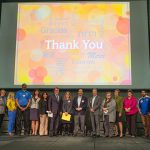
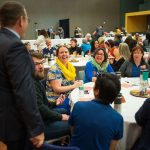
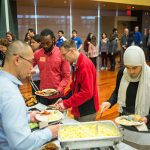
On Nov. 9, the Academic Affairs Leadership Team showed their gratitude for the nearly 500 dedicated staff members in the division who support students, faculty and administrators at the annual Academic Affairs Division Staff Appreciation Breakfast.

“I want to personally express my gratitude for your year-round commitment to supporting our division,” said Provost and Senior Vice President for Academic Affairs Andy Feinstein, noting that some staff members provide positive touchpoints for students while others have important behind-the-scenes roles. “All of you have an important hand in the success of our students and the university on a daily basis. You are integral to the quality of life on our campus and I thank each and every one of you.”

At the breakfast, each of the college deans and unit heads took a turn sharing a personal thank you to their employees. The festivities included drawings for gift baskets – one per college or unit – as well as other prizes.

This year, staff members were asked to share their own “shouts outs” to coworkers for doing exemplary work. The dozens of comments exemplified the characteristics and actions that make Spartan staff members so great: they greet students with grace and enthusiasm; they go the extra mile; they are patient and funny; they are team players.

Entertainment this year again included a photo booth where coworkers took silly snapshots with props (photos can be viewed online) and Grupo Folklorico Luna y Sol de San Jose State, a group of SJSU students who perform traditional Mexican dances. See more photos from the event online.

Faculty Matter Tip #30: This One is For You – the Importance of Self-Care

Our lives – as well as those of our students – are complex, and the final weeks of the semester always seem to bring a large number (and great variety) of unexpected and challenging complications and disruptions.  It can be very difficult to keep our many spinning plates  “strategically counterpoised”, a phrase I borrow from our colleague Cindy Baer, Assistant Professor of English and Comparative Literature. As research on stress and coping suggest, it is much easier to marshal the energy and patience and compassion to arrive at good solutions when we don’t already feel exhausted and tapped out.

The gist of this tip is fairly simple. Most of us are familiar with the instructions on the laminated card found in airplane seat-back pockets: Put your own oxygen mask on first, and then help others around you with theirs.  As we approach the Thanksgiving Break and then the final push of the semester, we encourage you to tend to your own needs – for sleep, for exercise, for nutritious food, for calm, for uplifting and affirming human contact, for spiritual renewal, for opportunities to connect with what matters most to you, for time to catch your breath.

SJSU has an institutional membership to the National Center for Faculty Development and Diversity.  This entitles all faculty to free access to a number of resources focused on self-care and work-life balance.  Our own Center for Faculty Development also offers sessions on these and related topics.  Coming up later this month: Self-care and time-management strategies for the end of the semester and beyond, Monday 11/27 from 1-2pm and Tuesday 11/28 from 12-1 both in IRC 210. Please sign up online.

Note:  Below, please find a section of an earlier Faculty Matter post, to remind you of the many resources our students can draw upon as they gear up for the next few weeks:

Peer Connections provides one on one appointments for peer mentoring and tutoring. They also offer several workshops a month on academic success skills. The Writing Center offers one on one tutoring for writing, online resources, and workshops. The Communications Center has drop-in17 and one on one appointments for oral and written communication. There are also numerous tutoring centers in the departments and colleges listed on the Tutoring Hub.

Educational Counseling provides one on one appointments, workshops, and online resources for academic success. The library has technology workshops. In addition, the library offers resources to support students in research, including details online to help the student define the type of resources and help they need and how to connect with a librarian. The library also has laptop and iPad rentals, meeting rooms that can be reserved for teamwork or collaboration, and online resources on referencing and literature reviews and tutorials on plagiarism. The Spartan Success Portal has a range of online, academic success modules.

You can read all previous tips on the Faculty Matter Tips page of the CFD website, and share your own thoughts and ideas on the Provost’s Academic Spotlight blog by commenting below.